
首页

归档

关于

友链
CSAPP Cache Lab

CSAPP Cache Lab

文章目录

  1. 1. Part A
  2. 2. Part B
    1. 2.1. 32*32
    2. 2.2. 64*64
    3. 2.3. 61*67
  3. 3. Summary
z0z0r4
z0z0r4
文章
16
分类
14
标签
12

首页

归档

关于

友链
2026-04-09 2026-04-10

这是 CSAPP Lab 记录的第五弹————CacheLab。

在此放一张在笔记本上跑出来的 Memory Mountain。
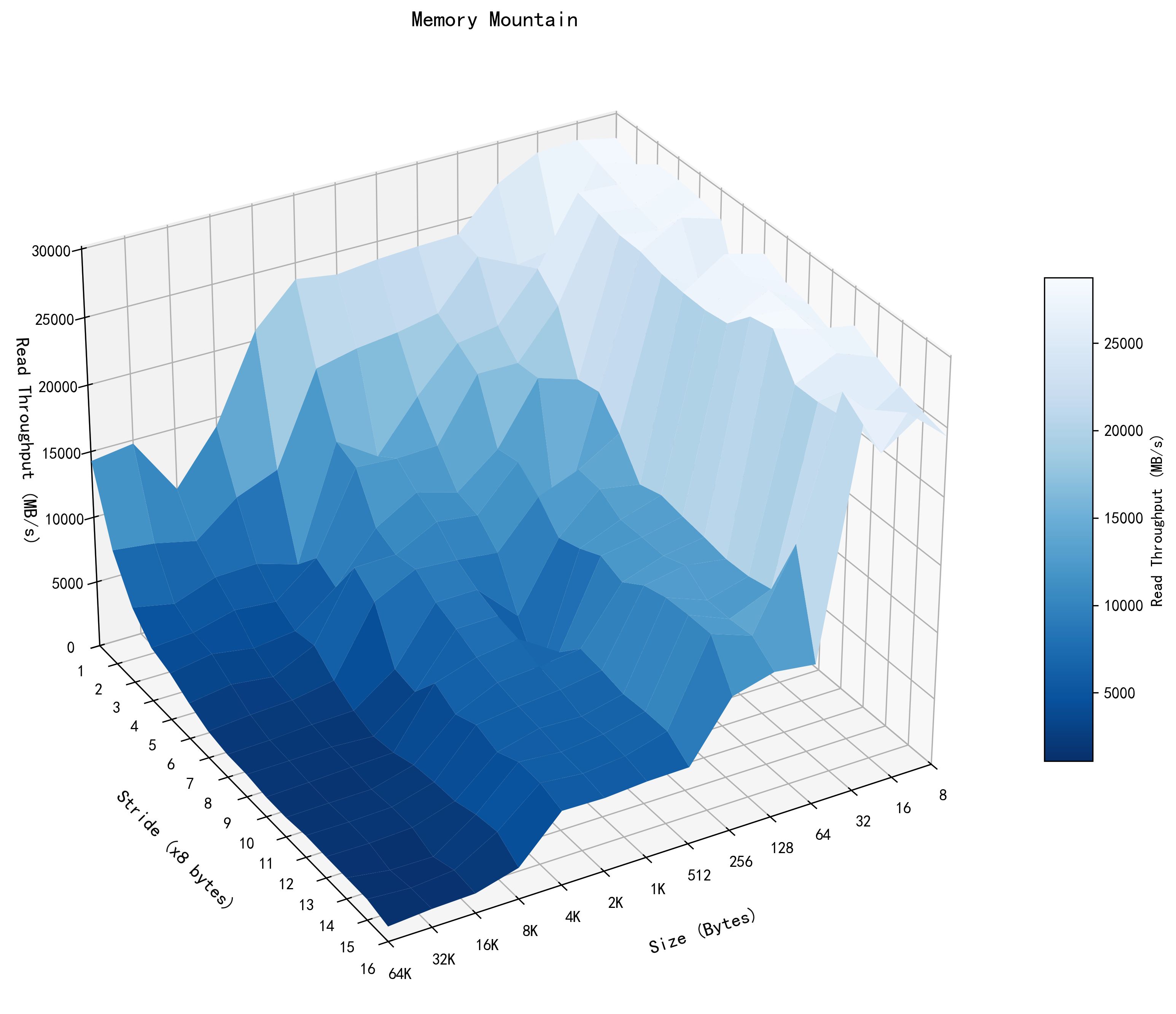
Memory Mountain

配置如下:

1
2
3
4
5
6
7
8
9
10
11
12
13
14
15
16
17
18
19
20
21
22
23
24
❯ fastfetch
_,met$$$$$gg. z0z0r4@DESKTOP-TKC6ATT
,g$$$$$$$$$$$$$$$P. ----------------------
,g$$P"" """Y$$.". OS: Debian GNU/Linux 13 (trixie) x86_64
,$$P' `$$$. Host: Windows Subsystem for Linux - Debian (2.6.3.0)
',$$P ,ggs. `$$b: Kernel: Linux 6.6.87.2-microsoft-standard-WSL2
`d$$' ,$P"' . $$$ Uptime: 10 hours, 52 mins
$$P d$' , $$P Packages: 1446 (dpkg)
$$: $$. - ,d$$' Shell: zsh 5.9
$$; Y$b._ _,d$P' Display (rdp-0): 2560x1440 @ 60 Hz
Y$$. `.`"Y$$$$P"' WM: WSLg 1.0.71 (Wayland)
`$$b "-.__ Terminal: Windows Terminal
`Y$$b CPU: Intel(R) Core(TM) i5-9300H (8) @ 2.40 GHz
`Y$$. GPU 1: NVIDIA GeForce GTX 1650 (3.84 GiB) [Discrete]
`$$b. GPU 2: Intel(R) UHD Graphics 630 (128.00 MiB) [Integrated]
`Y$$b. Memory: 1.42 GiB / 15.54 GiB (9%)
`"Y$b._ Swap: 0 B / 4.00 GiB (0%)
`"""" Disk (/): 30.70 GiB / 1006.85 GiB (3%) - ext4
Disk (/mnt/c): 151.75 GiB / 169.60 GiB (89%) - 9p
Disk (/mnt/d): 289.54 GiB / 305.89 GiB (95%) - 9p
Disk (/mnt/e): 529.46 GiB / 931.50 GiB (57%) - 9p
Local IP (eth0): 192.168.1.220/24
Battery (Microsoft Hyper-V Virtual Battery): 97% [AC Connected]
Locale: en_US.UTF-8

PartA 参考自 CSAPP第六章 - 存储器层次结构(Part B 他写的太玄乎看不懂)。

在 Lab Assignments 下载 cachelab-handout.tar。

以下只需要修改 csim.c 和 trans.c 两个文件。

Part A

按照要求完成一个简单的 cache 模拟器。

  1. 读取用 Valgrind 的内存访问记录生成的 .trace 文件,每一行格式为 <op> <addr> <size>,其中 <op> 是 L(load)或 S(store)或者 M(modify),<addr> 是内存地址,<size> 是访问字节数。

  2. 读取 CLI 参数构建缓存,其中 -s <s> 是 set index 的位数,-E <E> 是每个 set 中的行数,-b <b> 是 block offset 的位数。

  3. 模拟访问,其中 L 和 S 代表一次访问,M 代表两次访问(一次 load 一次 store)。每次访问都要判断是命中、未命中还是替换。当没有空余行的时候,按照 LRU 策略,淘汰最近最久未被使用的行。(注意替换也算一次未命中)

  4. 按照读取的 traces 的顺序模拟对 cache 的访问,统计命中、未命中和替换的次数,传给 printSummary 函数输出。

参考实现
1
2
3
4
5
6
7
8
9
10
11
12
13
14
15
16
17
18
19
20
21
22
23
24
25
26
27
28
29
30
31
32
33
34
35
36
37
38
39
40
41
42
43
44
45
46
47
48
49
50
51
52
53
54
55
56
57
58
59
60
61
62
63
64
65
66
67
68
69
70
71
72
73
74
75
76
77
78
79
80
81
82
83
84
85
86
87
88
89
90
91
92
93
94
95
96
97
98
99
100
101
102
103
104
105
106
107
108
109
110
111
112
113
114
115
116
117
118
119
120
121
122
123
124
125
126
127
128
129
130
131
132
133
134
135
136
137
138
139
140
141
142
143
144
145
146
147
148
149
150
151
152
153
154
155
156
157
158
159
160
161
162
163
164
165
166
167
168
169
170
171
172
173
174
175
176
177
178
179
180
181
182
183
184
185
186
187
188
189
190
#include "cachelab.h"
#include <stdio.h>
#include <stdlib.h>
#include <time.h>

char *file_name;
int s, E, b, group_cnt, trace_count;
int hit_count = 0, miss_count = 0, eviction_count = 0;
struct cacheGroup *cache;

struct trace
{
char operation;
int address;
int size;
};

struct cacheRow
{
int valid;
long long tag;
int last_time;
};

struct cacheGroup
{
struct cacheRow *lines;
};

void parseAddress(int address, int *group_index, long long *tag, int *block_offset)
{
*group_index = (address >> b) & ((1 << s) - 1);
*tag = (long long)(address >> (b + s));
*block_offset = address & ((1 << b) - 1);
}

struct trace *readTraceFile()
{
FILE *file = fopen(file_name, "r");
if (file == NULL)
{
fprintf(stderr, "Error opening file: %s\n", file_name);
exit(1);
}
char operation;
int address, size;
int traces_size = 1000;
struct trace *traces = malloc(sizeof(struct trace) * traces_size);
trace_count = 0;
while (fscanf(file, " %c %x,%d", &operation, &address, &size) == 3)
{
struct trace t = {operation, address, size};
*(traces + trace_count++) = t;
if (trace_count >= traces_size)
{
traces_size *= 2;
traces = realloc(traces, sizeof(struct trace) * traces_size);
}
}
fclose(file);
return traces;
}

int str2int(char *str)
{
int result = 0;
while (*str)
{
result = result * 10 + (*str - '0');
str++;
}
return result;
}

void parseArguments(int argc, char *argv[])
{
for (int i = 1; i < argc; i += 2)
{
if (argv[i][1] == 't')
{
file_name = argv[i + 1];
}
else
{
int val = str2int(argv[i + 1]);
switch (argv[i][1])
{
case 's':
s = val;
break;
case 'E':
E = val;
break;
case 'b':
b = val;
break;
}
}
}
group_cnt = 1 << s;
}

void touchCache(int group_index, long long tag)
{
int empty_line_index = -1;
for (int i = 0; i < E; i++)
{
if (cache[group_index].lines[i].valid && cache[group_index].lines[i].tag == tag)
{
// hit case
cache[group_index].lines[i].last_time = clock();
hit_count++;
return;
}
else
{
if (!cache[group_index].lines[i].valid)
{
// record empty line
empty_line_index = i;
}
}
}

miss_count++;

// if group has empty line
if (empty_line_index != -1)
{
cache[group_index].lines[empty_line_index].valid = 1;
cache[group_index].lines[empty_line_index].tag = tag;
cache[group_index].lines[empty_line_index].last_time = clock();
return;
}

// if we reach here, where no empty line, it means we have a miss and need to evict
eviction_count++;
int lru_index = 0;
for (int i = 1; i < E; i++)
{
if (cache[group_index].lines[i].last_time < cache[group_index].lines[lru_index].last_time)
{
lru_index = i;
}
}

// evict the LRU line
cache[group_index].lines[lru_index].tag = tag;
cache[group_index].lines[lru_index].last_time = clock();
}

void simulateCache(struct trace *traces)
{
cache = malloc(sizeof(struct cacheGroup) * group_cnt);
for (int i = 0; i < group_cnt; i++)
{
cache[i].lines = malloc(sizeof(struct cacheRow) * E);
for (int j = 0; j < E; j++)
{
cache[i].lines[j].valid = 0;
cache[i].lines[j].tag = 0;
cache[i].lines[j].last_time = 0;
}
}

for (int i = 0; i < trace_count; i++)
{
int group_index, block_offset;
long long tag;
parseAddress(traces[i].address, &group_index, &tag, &block_offset);
if (traces[i].operation == 'L' || traces[i].operation == 'S')
{
touchCache(group_index, tag);
}
else if (traces[i].operation == 'M')
{
touchCache(group_index, tag);
}
}
}

int main(int argc, char *argv[])
{
parseArguments(argc, argv);
struct trace *traces = readTraceFile();
simulateCache(traces);
printSummary(hit_count, miss_count, eviction_count);
return 0;
}

Part B

完成对 32×3232 \times 3232×32、64×6464 \times 6464×64 和 61×6761 \times 6761×67 三种矩阵的转置优化,在 trans.c 中实现 transpose_submit 函数。

最简单的实现当然是直接挨个交换元素:

1
2
3
4
5
6
7
8
9
10
11
12
13
14
15
16
/* 
* trans - A simple baseline transpose function, not optimized for the cache.
*/
char trans_desc[] = "Simple row-wise scan transpose";
void trans(int M, int N, int A[N][M], int B[M][N])
{
int i, j, tmp;

for (i = 0; i < N; i++) {
for (j = 0; j < M; j++) {
tmp = A[i][j];
B[j][i] = tmp;
}
}

}

参考 cachelab.pdf 中 5.2.1 Performance 说到

For each matrix size, the performance of your transpose_submit function is evaluated by using
valgrind to extract the address trace for your function, and then using the reference simulator to replay
this trace on a cache with parameters (s = 5, E = 1, b = 5).

那么最多有 25=322^5 = 3225=32 个缓存行,每行长度为 25=322^5 = 3225=32 字节,每个 int 元素占 4 字节,所以每行可以存储 8 个元素。

32*32

对于 32×3232 \times 3232×32 的矩阵,我们可以将其分成 8×88 \times 88×8 的小块进行转置。

1
2
3
4
5
6
7
8
9
10
11
12
13
14
15
16
17
18
19
20
void transpose_block(int M, int N, int A[N][M], int B[M][N], int si, int sj, int block_length) {
int i, j, tmp;
for (i = si; i < si + block_length && i < N; i++) {
for (j = sj; j < sj + block_length && j < M; j++) {
tmp = A[i][j];
B[j][i] = tmp;
}
}
}

void transpose_submit(int M, int N, int A[N][M], int B[M][N])
{
int i, j;
int block_length = 8;
for (i = 0; i < N; i+=block_length) {
for (j = 0; j < M; j+=block_length) {
transpose_block(M, N, A, B, i, j, block_length);
}
}
}

结果为

1
2
3
4
5
6
7
8
9
10
11
12
13
❯ ./test-trans -M 32 -N 32

Function 0 (2 total)
Step 1: Validating and generating memory traces
Step 2: Evaluating performance (s=5, E=1, b=5)
func 0 (Transpose submission): hits:1709, misses:344, evictions:312

Function 1 (2 total)
Step 1: Validating and generating memory traces
Step 2: Evaluating performance (s=5, E=1, b=5)
func 1 (Simple row-wise scan transpose): hits:869, misses:1184, evictions:1152

Summary for official submission (func 0): correctness=1 misses=344

以上是逐个元素交换,那么假如 A[i] 行映射的组和 B[j] 行的映射的组相同,那么在访问 B[j][i] 时会踢出 A[i] 行存入 B[j],继续交换到 B[j+1] 时也需要读取 A[i] 行得到 A[i][j+1],就会一直互相冲突。

显然如果一次性取出 A[i][j] 到 A[i][j+7] 的 8 个元素存入寄存器中,就算写入 B[j] 有冲突,那么就可以避免上述问题。

1
2
3
4
5
6
7
8
9
10
11
12
13
14
15
16
17
18
19
20
21
22
void transpose_block(int M, int N, int A[N][M], int B[M][N], int si, int sj, int block_length) {
int a0, a1, a2, a3, a4, a5, a6, a7;
for (int i = si; i < si + block_length && i < N; i++) {
a0 = A[i][sj];
a1 = A[i][sj + 1];
a2 = A[i][sj + 2];
a3 = A[i][sj + 3];
a4 = A[i][sj + 4];
a5 = A[i][sj + 5];
a6 = A[i][sj + 6];
a7 = A[i][sj + 7];

B[sj][i] = a0;
B[sj + 1][i] = a1;
B[sj + 2][i] = a2;
B[sj + 3][i] = a3;
B[sj + 4][i] = a4;
B[sj + 5][i] = a5;
B[sj + 6][i] = a6;
B[sj + 7][i] = a7;
}
}

结果为

1
2
3
4
5
6
7
8
9
10
11
12
13
14
15
❯ ./test-trans -M 32 -N 32

Function 0 (2 total)
Step 1: Validating and generating memory traces
Step 2: Evaluating performance (s=5, E=1, b=5)
func 0 (Transpose submission): hits:1765, misses:288, evictions:256

Function 1 (2 total)
Step 1: Validating and generating memory traces
Step 2: Evaluating performance (s=5, E=1, b=5)
func 1 (Simple row-wise scan transpose): hits:869, misses:1184, evictions:1152

Summary for official submission (func 0): correctness=1 misses=288

TEST_TRANS_RESULTS=1:288

以下是做完整个实验之后的复盘。在进入 64*64 之前,这里应该思考一下:

  • 为什么在 B 竖着写入的时候,B 的每一行之间不会有冲突?

考虑到一个缓存行可以存 32 bytes,也就是 8 个元素,由于 32*32 的矩阵每行有 32 个元素,所以每行占用 4 个缓存行,每 8 行才会将内存映射到同一行中。而分块为 8*8,这决定了分块矩阵内任意两行不可能映射到同一行中,因此自身行之间不会有冲突。

  • 什么情况下 B 的行之间可能有冲突?假如有冲突会发生什么?

考虑下方的 64*64 的矩阵,每行有 64 个元素,占用 8 个缓存行,每 4 行就会映射到同一行中。如果分块为 8*8,这决定了分块矩阵内 0~3 行和 4~7 行会分别映射到同一行中,因此在写入 B 的时候,前 4 行和后 4 行互相踢出缓存。

  • 剩下的 288 个未命中是怎么产生的?

当分块在对角线上时,A 和 B 的分块的每一行都映射到同一行中,导致大量未命中。

非对角线上的分块应该不会这样。

64*64

8×88 \times 88×8 的块大小直接套用到 64×6464 \times 6464×64 的矩阵上,结果很差:

1
2
3
4
5
6
7
8
9
10
11
12
13
14
15
❯ ./test-trans -M 64 -N 64

Function 0 (2 total)
Step 1: Validating and generating memory traces
Step 2: Evaluating performance (s=5, E=1, b=5)
func 0 (Transpose submission): hits:3585, misses:4612, evictions:4580

Function 1 (2 total)
Step 1: Validating and generating memory traces
Step 2: Evaluating performance (s=5, E=1, b=5)
func 1 (Simple row-wise scan transpose): hits:3473, misses:4724, evictions:4692

Summary for official submission (func 0): correctness=1 misses=4612

TEST_TRANS_RESULTS=1:4612

将 block_length 改为 16 之后,为什么结果没变…?依旧是 hits:3585, misses:4612, evictions:4580。

这个模拟器是不是有问题.jpg 按道理 block_length 从 8 变成 16,misses 应该会增加才对
但是对于 32×3232 \times 3232×32 的矩阵倒是显著增大了 misses,从 288 增加到了 1156

1
2
3
4
5
6
7
8
9
10
11
12
13
14
15
❯ ./test-trans -M 32 -N 32

Function 0 (2 total)
Step 1: Validating and generating memory traces
Step 2: Evaluating performance (s=5, E=1, b=5)
func 0 (Transpose submission): hits:897, misses:1156, evictions:1124

Function 1 (2 total)
Step 1: Validating and generating memory traces
Step 2: Evaluating performance (s=5, E=1, b=5)
func 1 (Simple row-wise scan transpose): hits:869, misses:1184, evictions:1152

Summary for official submission (func 0): correctness=1 misses=1156

TEST_TRANS_RESULTS=1:1156

既然矩阵每四行就会映射到同一行中,那么考虑分块为 4×44 \times 44×4,这样就可以保证分块内任意两行都不会映射到同一行中,结果如下:

1
2
3
4
5
6
7
8
9
10
11
12
13
14
15
❯ ./test-trans -M 64 -N 64

Function 0 (2 total)
Step 1: Validating and generating memory traces
Step 2: Evaluating performance (s=5, E=1, b=5)
func 0 (Transpose submission): hits:6497, misses:1700, evictions:1668

Function 1 (2 total)
Step 1: Validating and generating memory traces
Step 2: Evaluating performance (s=5, E=1, b=5)
func 1 (Simple row-wise scan transpose): hits:3473, misses:4724, evictions:4692

Summary for official submission (func 0): correctness=1 misses=1700

TEST_TRANS_RESULTS=1:1700

满分要求是 1300 个未命中。

虽然这样也优化了,但缓存行每次读取 8 个元素而只利用了 4 个元素,非常浪费。

经过和 AI 与 参考的殊死搏斗,折磨一晚上,终于跌跌撞撞理解了以下内容

将矩阵 A 和 B 按照 8×88 \times 88×8 的块进行划分后再对分块划分为 4×44 \times 44×4 的子块,分别为 A11,A12,A21,A22A_{11}, A_{12}, A_{21}, A_{22}A11​,A12​,A21​,A22​,以及 B11,B12,B21,B22B_{11}, B_{12}, B_{21}, B_{22}B11​,B12​,B21​,B22​。

我们可以轻松转置 A11A_{11}A11​ 到 B11B_{11}B11​,A22A_{22}A22​ 到 B22B_{22}B22​,但是还有 A12A_{12}A12​ 和 A21A_{21}A21​。

又因为我们需要想办法利用读取 A11A_{11}A11​ 的时候读取到的 A12A_{12}A12​(也就是已经读取了 A 的前四行),但是又不能直接写入完 B11B_{11}B11​ 后再写入 B21B_{21}B21​ (每四行冲突)。

而写入 B11B_{11}B11​ 的时候,B12B_{12}B12​ 也会被缓存,而 B12B_{12}B12​ 是空的。这样就可以利用 B12B_{12}B12​ 来暂存 A12A_{12}A12​ 的数据。(可以先将 A21A_{21}A21​ 转置到 B12B_{12}B12​)

以上是第一步,然后第二步是将 A21A_{21}A21​ 转置到 B12B_{12}B12​,同时将 B12B_{12}B12​ 中的 A12TA_{12}^TA12T​ 写入 B11B_{11}B11​。

最后,第三步,将 A22A_{22}A22​ 转置到 B22B_{22}B22​。

1
2
3
4
5
6
7
8
9
10
11
12
13
14
15
16
17
18
19
20
21
22
23
24
25
26
27
28
29
30
31
32
33
34
35
36
37
38
39
40
41
42
43
44
45
46
47
48
49
50
51
52
53
54
55
56
57
58
59
60
61
62
63
64
65
66
67
68
69
70
71
72
73
74
75
76
77
78
79
80
81
82
83
84
85
86
87
88
89
90
91
92
93
94
95
96
97
98
99
100
101
102
103
104
105
106
107
108
109
110

void transpose_block_8_for_64_64(int M, int N, int A[N][M], int B[M][N], int si, int sj)
{
int a0, a1, a2, a3, a4, a5, a6, a7;
for (int i = si; i < si + 4; i++)
{
a0 = A[i][sj];
a1 = A[i][sj + 1];
a2 = A[i][sj + 2];
a3 = A[i][sj + 3];

a4 = A[i][sj + 4];
a5 = A[i][sj + 5];
a6 = A[i][sj + 6];
a7 = A[i][sj + 7];

B[sj][i] = a0;
B[sj + 1][i] = a1;
B[sj + 2][i] = a2;
B[sj + 3][i] = a3;

// A12 -> B12,先转置,后续直接平移列到 B21
B[sj + 0][i + 4] = a4;
B[sj + 1][i + 4] = a5;
B[sj + 2][i + 4] = a6;
B[sj + 3][i + 4] = a7;
}

/* 这个版本会在 B 的 0~3 和 4~7 之间读写,缓存失效 */
// for (int i = si + 4; i < si + 8; i++)
// {
// // read A21 line
// a0 = A[i][sj];
// a1 = A[i][sj + 1];
// a2 = A[i][sj + 2];
// a3 = A[i][sj + 3];

// // read B12 column
// a4 = B[sj][i];
// a5 = B[sj + 1][i];
// a6 = B[sj + 2][i];
// a7 = B[sj + 3][i];

// // write A21 line to B12 column
// B[sj][i] = a0;
// B[sj + 1][i] = a1;
// B[sj + 2][i] = a2;
// B[sj + 3][i] = a3;

// // write B21 column
// B[sj + 4][i - 4] = a4;
// B[sj + 5][i - 4] = a5;
// B[sj + 6][i - 4] = a6;
// B[sj + 7][i - 4] = a7;
// }

/* 这个版本按列读取 A 然后按行写入 B 失效数量明显减少 */
for (int j = sj; j < sj + 4; j++)
{
// read A21 column
a0 = A[si + 4][j];
a1 = A[si + 5][j];
a2 = A[si + 6][j];
a3 = A[si + 7][j];

// read B12 row
a4 = B[j][si + 4];
a5 = B[j][si + 5];
a6 = B[j][si + 6];
a7 = B[j][si + 7];

// write A21 column to B12 row
B[j][si + 4] = a0;
B[j][si + 5] = a1;
B[j][si + 6] = a2;
B[j][si + 7] = a3;

// write B12 row to B21 row
B[j + 4][si] = a4;
B[j + 4][si + 1] = a5;
B[j + 4][si + 2] = a6;
B[j + 4][si + 3] = a7;
}

// A22 -> B22, 直接转置
for (int i = si + 4; i < si + 8; i++)
{
a0 = A[i][sj + 4];
a1 = A[i][sj + 4 + 1];
a2 = A[i][sj + 4 + 2];
a3 = A[i][sj + 4 + 3];

B[sj + 4][i] = a0;
B[sj + 4 + 1][i] = a1;
B[sj + 4 + 2][i] = a2;
B[sj + 4 + 3][i] = a3;
}
}

void transpose_64_64(int M, int N, int A[N][M], int B[M][N])
{
int block_length = 8;
for (int i = 0; i < N; i += block_length)
{
for (int j = 0; j < M; j += block_length)
{
transpose_block_8_for_64_64(M, N, A, B, i, j);
}
}
}

测试得到:

1
2
3
4
5
6
7
8
9
10
11
12
13
14
15
❯ ./test-trans -M 64 -N 64

Function 0 (2 total)
Step 1: Validating and generating memory traces
Step 2: Evaluating performance (s=5, E=1, b=5)
func 0 (Transpose submission): hits:9065, misses:1180, evictions:1148

Function 1 (2 total)
Step 1: Validating and generating memory traces
Step 2: Evaluating performance (s=5, E=1, b=5)
func 1 (Simple row-wise scan transpose): hits:3473, misses:4724, evictions:4692

Summary for official submission (func 0): correctness=1 misses=1180

TEST_TRANS_RESULTS=1:1180

其实和 32*32 的过程没有太多差别,只是多了个每四行冲突的问题。

实验工具的分析细粒度还是有点低,只有 Summary,也许有需要可以根据 trace 来具体分析吧…

61*67

测试 4、8、16 的分块,可以发现 16 的分块效果最好,通过了…

我还以为又有奇淫巧计,参考前人史料发现寥寥两行

此时 61 不是二次幂,冲突不在对角线上,或许减少?没分析…

Summary

注意:driver.py 是 Python2 写的,得改成 Python3 才能运行。

最终结果:

1
2
3
4
5
6
7
8
9
10
11
12
13
14
15
16
17
18
19
20
21
22
23
24
25
26
27
28
❯ python3 driver.py
Part A: Testing cache simulator
Running ./test-csim
Your simulator Reference simulator
Points (s,E,b) Hits Misses Evicts Hits Misses Evicts
3 (1,1,1) 9 8 6 9 8 6 traces/yi2.trace
3 (4,2,4) 4 5 2 4 5 2 traces/yi.trace
3 (2,1,4) 2 3 1 2 3 1 traces/dave.trace
3 (2,1,3) 167 71 67 167 71 67 traces/trans.trace
3 (2,2,3) 201 37 29 201 37 29 traces/trans.trace
3 (2,4,3) 212 26 10 212 26 10 traces/trans.trace
3 (5,1,5) 231 7 0 231 7 0 traces/trans.trace
6 (5,1,5) 265189 21775 21743 265189 21775 21743 traces/long.trace
27


Part B: Testing transpose function
Running ./test-trans -M 32 -N 32
Running ./test-trans -M 64 -N 64
Running ./test-trans -M 61 -N 67

Cache Lab summary:
Points Max pts Misses
Csim correctness 27.0 27
Trans perf 32x32 8.0 8 288
Trans perf 64x64 8.0 8 1180
Trans perf 61x67 10.0 10 1993
Total points 53.0 53

这一天下来,问了无数次 AI。实测对于这些内容,训练时应该有 Cache Lab 的语料,AI 可以提供一份能通过的代码,但是没法解释清楚(起码我没听懂),未能给出关键矛盾。也许是语料里也没有分析过程吧…那这篇文章说不定也会被拿去训练?不过可能因为质量太差被清洗掉吧…

CSAPP Arch Lab
后一篇

CSAPP Arch Lab

说些什么吧!

giscus
Creative Commons License All website licensed under CC BY 4.0
2025-2026 z0z0r4
基于 Hexo  Theme.Reimu
81.8k  |  06:45
粤ICP备2025511811号
粤公网安备44130302100361号
总访问量   |  总访客量 

文章目录

  1. 1. Part A
  2. 2. Part B
    1. 2.1. 32*32
    2. 2.2. 64*64
    3. 2.3. 61*67
  3. 3. Summary
z0z0r4
z0z0r4
文章
16
分类
14
标签
12

首页

归档

关于

友链